








News
Wayne Christian's Press Room
News Items - 2026
-
RRC Hosts Canadian Delegation
March 17, 2026
Led by the Canadian Conservative Leader Pierre Poilievre, the delegation received a briefing on the RRC’s regulatory duties and learned about Texas’ global leadership in energy development.

Canadian Conservative Leader Pierre Poilievre (left) and Railroad Commission of Texas Chairman Jim Wright shake hands during a meeting at the RRC headquarters in Austin, March 17, 2026.
“It was an honor to host Canadian Conservative Leader Pierre Poilievre at the Railroad Commission of Texas,” said RRC Chairman Jim Wright. “As a native of the Canadian oil and gas producing province of Alberta, Leader Poilievre understands that energy security and common-sense regulatory policies serve as the foundation of a strong economy.”
As the regulator of one of the most dynamic energy economies in the world, the RRC routinely hosts foreign delegations including representatives from Germany and Argentina last year. Also in 2025, Canadian financial leaders visited Austin where they learned about the Commission’s longstanding relationship with Canadian provinces, including collaboration through the Interstate Oil and Gas Compact Commission.
“The Railroad Commission of Texas has a long and storied history prioritizing common-sense, pro-growth energy policies and it was a pleasure to discuss the Commission’s outlook and approach with our northern neighbors,” he added.
This visit is just the latest example of how the RRC remains at the forefront of the global conversation on energy production and regulation.
-
Commissioner Wayne Christian Praises Record Port Activity, Rising Oil Production in Texas
May 06, 2026
AUSTIN – Texas oil and gas regulator Wayne Christian praised reports highlighting the state’s growing role in meeting global energy demand amid instability abroad. Last month, the Port of Corpus Christi reported its strongest first quarter on record. Meanwhile, Diamondback Energy announced this week that it is boosting exports and expanding drilling activity in response to Iran-related supply disruptions, both of which reflect shifting market conditions and the ongoing strength of Texas oil production.
The following statement may be attributed to Texas oil and gas regulator Wayne Christian:
“The conflict in Iran is a clear reminder of the world’s reliance on Texas oil and gas. When America and our allies need stability, Texas energy is answering the call. What we are seeing right now is no accident. It is the result of sustained investment in our drilling capacity and world-class export infrastructure. Simply put, Texas leads the free world in energy production because we have built the foundation to do so.
As prices rise at the pump here at home and abroad, the path forward is clear: further unleash Texas energy. We need to lower taxes, cut regulations, and eliminate green energy subsidies because this surge in oil and gas production should not be short-lived. Texas should remain the cornerstone of global energy supply, delivering affordable, reliable energy to Americans and our allies around the world.”
-
Oil & Gas Regulator Wayne Christian: Act Now to Curb Debt Growth and Protect U.S. Energy and Economic Security
May 12, 2026
AUSTIN – Texas oil and gas regulator Wayne Christian today warned of growing threats to America’s economic stability, citing record federal debt exceeding U.S. GDP, persistent inflation squeezing working families, and rising geopolitical tensions in key global energy corridors such as the Strait of Hormuz. He also noted efforts by Iran and other actors to shift oil transactions away from the U.S. dollar and toward the Chinese yuan, stating that these developments, combined with coordinated efforts by foreign adversaries to weaken American energy dominance, represent a direct challenge to U.S. financial strength and global influence.
“America is facing a financial threat unlike anything in modern history,” Christian said. “Our national debt is exploding, inflation continues to squeeze working families, and foreign adversaries are actively trying to undermine the U.S. dollar and weaken America’s economic power. As a former banker and financial professional, I can tell you the greatest danger we face is hyperinflation and the collapse of the dollar’s global dominance. Hostile regimes, namely China and Iran, are pushing to replace the dollar with the Chinese yuan in energy markets while also targeting American energy leadership, and radical activists continue attacking the very industry that keeps this country running.”
Christian also emphasized the central role of Texas energy in sustaining the global financial system tied to the U.S. dollar.
“Simply put, reliable energy security is both economic security and national security. The dollar remains the world’s strongest currency because global energy markets trade in U.S. dollar, and Texas sits at the center of that system as the nation’s leading producer and exporter of oil and natural gas,” he said. “If inflation spirals out of control and the petrodollar weakens, Americans will see their buying power collapse, our economy deteriorate, and global trade systems destabilize in ways that threaten the financial foundation of the United States.”
Christian added that geopolitical rivals understand the strategic importance of American and Texas energy dominance.
“Our foreign adversaries, China and Iran in particular, understand that weakening American energy, especially Texas energy, weakens America itself,” he said. “As a nation, we must fight tooth and nail to safeguard reliable energy and the petrodollar, aggressively curb the unchecked proliferation of national debt as a top priority to restore fiscal discipline, strengthen the U.S. dollar, expand critical infrastructure, and ensure the United States remains the world’s dominant energy superpower.”
-
Oil and Gas Regulator Wayne Christian Highlights Permian Basin’s Key Role in America’s Record Energy Output
May 14, 2026
AUSTIN — Texas oil and gas regulator Wayne Christian today highlighted the critical role Texas’ energy industry and the Permian Basin have played in maintaining America’s position as the world’s largest oil and energy producer. Christian also pointed to new federal data from the U.S. Energy Information Administration (EIA) showing continued U.S. production strength fueled by Texas energy.
“The Permian Basin is the engine of Texas and American energy independence,” Commissioner Wayne Christian said. “If we want to maintain global energy leadership, stabilize fuel prices and reduce reliance on adversarial nations, we must continue to support the men and women who power this industry every day right here in Texas.”
According to the EIA’s Today in Energy analysis released earlier this week, U.S. crude oil production reached record highs again in 2025, with production from the Permian Basin accounting for a dominant share of national growth, tallying an annual 3% increase. The region, stretching across West Texas and southeastern New Mexico, continues to serve as the backbone of U.S. energy supply, driving efficiency gains, record output and global energy leadership.
In 2025, crude oil accounted for 26% of total domestic energy production, helping the United States maintain its position as the world’s leading oil producer. The report also highlighted continued growth in national natural gas and coal production, reinforcing the critical role reliable energy sources play in meeting rising demand.
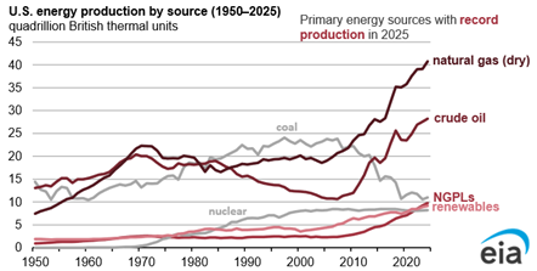
“Texas is the beating heart of American energy, and this report makes that unmistakably clear,” Wayne Christian continued. “That success is not accidental; it is the result of policies that spark growth in Texas’ energy sector, strengthen our economy and advance national energy independence.”
To view the report by the EIA’s Today in Energy analysis, click here.
-
Oil and Gas Regulator Wayne Christian Applauds Largest Onshore Lease Sale in U.S. History
May 22, 2026
AUSTIN — Texas oil and gas regulator Wayne Christian today applauded the reported $4 billion federal oil and gas lease sale in Texas and New Mexico, the largest onshore federal oil and gas lease sale in U.S. history. Christian emphasized that the record-setting sale reflects the results of the streamlined, cooperative federal regulatory environment under the Trump administration, which has facilitated increased leasing activity and market participation.
“The contrast between the Biden administration’s anti-energy agenda and President Trump’s pro-production policies could not be more obvious,” Christian said. “When the federal government allows American energy producers to do what they do best, investment surges, production grows, jobs are created and American energy security is strengthened. Under President Trump, America is once again unleashing the full power of domestic energy production.”
The lease sale, administered by the U.S. Department of the Interior (DOI)’s Bureau of Land Management, allows energy companies to bid for the right to explore for and produce oil and natural gas on federally owned land. Winning bidders secure leases on specific tracts, with development conducted under federal oversight. Revenue is generated through lease payments, royalties and production activity and is shared between state and federal governments.
According to preliminary auction results released by the DOI, companies bid more than $4 billion for drilling rights covering more than 33,000 acres across portions of the Permian Basin in Texas and New Mexico. That total is roughly four times the previous onshore federal lease sale record of $972 million set in 2018.
“This sale is further proof that Texas’ oil and gas industry is entering a new era of strength and stability,” Christian said. “After years of uncertainty and policies that slowed investment and constrained production, companies are once again expanding operations, increasing revenues and making long-term investments in American energy. Texas producers are leading that resurgence, and the results are benefiting workers, communities, state revenues and consumers across the Lone Star State.”
For more information on the historic oil and gas lease sale, see the DOI release here.
-
Wayne Christian Celebrates Nation-leading Texas Oil Production as Rig Activity and Jobs Rise
May 28, 2026
AUSTIN — Texas oil and gas regulator Wayne Christian today celebrated nation-leading Texas oil production growth, citing new data showing continued strength in Texas drilling activity and steady employment gains in the upstream sector.
“The market is sending a clear signal,” Christian said. “Stronger demand is driving renewed production and job growth across the oil industry. When producers have confidence in demand, production grows, which strengthens communities, supports energy security, and fuels opportunity.”
According to Baker Hughes, active U.S. oil-directed drilling rigs rose by 10 to 425 last week, with all of the gains occurring in Texas. The jump represents the largest weekly increase in more than four years and underscores the state’s continued leadership in upstream production growth. The rise also signals renewed momentum in drilling activity amid improving market conditions.
Separately, citing the latest Current Employment Statistics (CES) report from the U.S. Bureau of Labor Statistics (BLS), the Texas Independent Producers and Royalty Owners Association (TIPRO) highlighted that Texas upstream oil and natural gas employment increased by 400 jobs in April, following a gain of 1,800 jobs in March, reinforcing a clear upward trend in sector hiring.
“These increases provide a direct economic injection to the Texas economy,” Christian explained. “Rising oil and gas activity drives job growth, boosts production, and expands royalty payments for landowners, while generating critical revenue for schools, roads, and essential public services.”
TIPRO, citing data from the Texas Comptroller of Public Accounts, also reported that the state’s oil and natural gas industry generated more than $1.715 billion in oil production tax revenue between January and April 2026. Natural gas production taxes added another $773 million during the same period, helping fund public education, higher education, transportation infrastructure and other essential state services.
Christian also added that the latest data underscores the resilience of Texas energy producers and the importance of pro-growth energy policies as electricity demand continues to rise across the state.
“Whether powering the nation’s fastest-growing economy, homes, manufacturing or data centers, the answer is producing more reliable, affordable Texas energy,” Christian said. “Texas has the resources, workforce and infrastructure to meet its growing energy needs.”
To read the Baker Hughes report on oil rig count increases, visit here.
To read the TIPRO report on upstream employment growth, visit here.
-
Wayne Christian Praises Proposal to Streamline Federal Natural Gas Permitting, Strengthen Texas Energy Infrastructure
May 29, 2026
AUSTIN — Oil and gas regulator Wayne Christian today praised the Federal Energy Regulatory Commission (FERC)’s proposed overhaul of federal natural gas permitting regulations, calling it a critical step toward expanding energy infrastructure, strengthening grid reliability and ensuring Texas can meet rapidly growing electricity demand.
“Texas’ energy future depends on our ability to build infrastructure to meet rising demand,” Christian said. “This proposal recognizes that pipelines are essential infrastructure and that streamlining the permitting process is critical to keeping energy both affordable and reliable.”
The Notice of Proposed Rulemaking (NOPR) would modernize FERC’s blanket certificate program by significantly expanding the types of natural gas infrastructure projects eligible for streamlined federal approval. The proposal would also raise cost thresholds for qualifying projects, remove certain regulatory barriers and accelerate the development of infrastructure needed to deliver affordable, reliable energy to American consumers. The proposal is currently open to public comment before the FERC considers final adoption.
With new manufacturing facilities, industrial development and data centers driving unprecedented electricity demand in Texas, further energy infrastructure investments will be essential to maintaining reliability and affordability.
“Texas leads the nation in natural gas production, and we should use that advantage to strengthen our grid and power our growing economy,” Christian said. “The answer to rising electricity demand from data centers and new industry isn't to stop growth—it’s to build the infrastructure needed to support it.”
Christian adds that the proposal reflects a broader recognition that American energy dominance depends on modern infrastructure policies that allow critical projects to move forward efficiently.
“President Trump has made clear that American energy leadership requires American energy infrastructure,” Christian said. “This proposal removes unnecessary federal barriers to investment, strengthens Texas’ ability to meet future energy demand and reinforces the role of natural gas as the foundation of a reliable electric grid. I applaud President Trump and the FERC for taking an important step toward unleashing the full potential of Texas energy.”
For more information and to view FERC’s announcement, visit FERC’s website here.
-
Wayne Christian Hails Federal Decision Ending Dunes Sagebrush Lizard Endangered Species Act Protections
June 08, 2026
AUSTIN, Texas — Oil and gas regulator Wayne Christian today applauded the U.S. Fish and Wildlife Service’s (FWS) decision to revoke the Endangered Species Act listing of the dunes sagebrush lizard, a move that aims to resolve litigation pursued by Texas Attorney General Ken Paxton on behalf of the Railroad Commission of Texas (RRC) and marks what Christian called a significant victory against federal regulatory overreach affecting American energy production.
“For years, Texans watched the Obama and Biden administrations weaponize the Endangered Species Act against the people who power this country,” he said. “The goal was never about protecting wildlife. It was about using federal bureaucracy as a tool to restrict oil and gas production and undermine American energy independence.”
The lawsuit, filed by the State of Texas and unanimously supported by the RRC, several state agencies and industry stakeholders, challenged the FWS 2024 decision to list the species despite extensive voluntary conservation agreements in West Texas and southeastern New Mexico. The plaintiffs argued that the listing failed to adequately account for ongoing conservation efforts across a region that includes parts of the Permian Basin, the nation’s most productive oil and gas region.
“As I said years ago, conservation works best when it’s led by the men and women who work these lands every day, not by Washington bureaucrats weaponizing the Endangered Species Act against American energy,” Christian added. “Texas oil and gas producers have shown that responsible development and conservation can coexist, including in the Permian Basin, where voluntary agreements are already in place.”
In a court filing tied to the settlement, the FWS reportedly acknowledged that the 2024 listing relied on a “serious and fundamental” error and failed to properly account for ongoing conservation and habitat restoration efforts in Texas and New Mexico. The Justice Department said the mistake resulted in an incomplete evaluation of conservation efforts. The settlement is pending approval by the federal judge overseeing the case in Midland.
Christian concluded that the decision reflects a broader shift in federal policy.
“Environmental stewardship and energy production are not mutually exclusive,” Christian said. “This decision, along with the prior delisting of the lesser prairie-chicken and the halt of the Muleshoe National Wildlife Refuge expansion, demonstrates the Trump administration’s commitment to reversing years of federal overreach in which species listings were used to restrict land use, impede development and diminish domestic energy production. Under President Trump, species protections will no longer serve as a false pretext to block responsible development or penalize American energy producers.”
Commissioners
-
 Jim Wright
Chairman -
 Christi Craddick
Commissioner -
 Wayne Christian
Commissioner
Audiences